'Wild strawberries' short comment
Swedish art cinema
From Ingmar Bergman’s ‘Wild strawberries’ to discover the art cinema soul in Sweden.
General
Ingmar Bergman’s ‘wild strawberries’ is a romantic, not-so-heavy film compared to many of his other pieces. As an art film, ‘Wild strawberry’ is a perfect example in which you can go through your life journey and find some reflection of yourself. In life, people are moving either toward or away from each other (Koller, 2013, p.38); some people remain in your heart for a long time whom you may never forget; some people come and disappear afterward, you may hardly remember all of their names; still, their image may remain in your mind, show up in your dreams. The movie flow is a bit slow. The time zone of this film is short but intensive; it’s a one-day story (the Jambo of events); it starts from the first day in the morning to precisely the next day’s morning; in this one day journey, there are dreams or reality, now or the past, alive or dead, peace or conflict, joy or regrets, touchable or illusion. Bergman uses Isak as the first personas of a narrator to explain to us a story between his inner life and the communication with the outside world. You can find Ingmar Bergman’s typical film framework, the six spiritual elements of a human being in this movie, which are: judgment, abandonment, passion, turning towards other people, shame, vision (Koller, 2013, p.36).
Stories
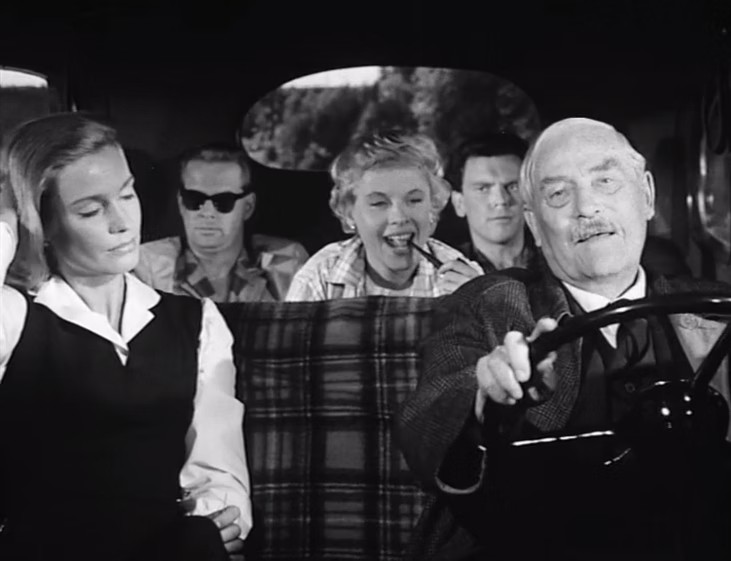
The 76 years old professor Isak wakes up from his nightmare in the morning and decides to drive from Stockholm to Lund, where he will receive his doctorate diploma. He brought his daughter in law since she wanted to go the same way; on the way back to Lund, he met some people he helped before at the gas station, passed by the old house where he lived before were outside of the house used to grow wild strawberries, he reminds about his first love Sara, from where also some hitchhikers including a young girl called Sara and her two boyfriends went into his car, they had a minor accident with a fighting couple who had a vehicle broken afterward. And the couple was in Isak’s car for a short time. After that, he passed by and went back to his mother’s place and visited her with his daughter-in-law. And at last, finally, he has reached his destination. At night, the young Sara and her friends came downstairs to say goodbye. And the movie ends up precisely the next day morning.
The beginning scene
The beginning of the wild strawberries is an unforgettable scene that can create a lot of imagination and a much different understanding of the whole movie. An old man Isak was on his bed alone, was dead or dreaming; the fiction scene made us remind ‘The Phantom Carriage’ by Victor Sjöström, who is also the actor for Isak Borg. The phantom came to Isak; does that means his life is over? In the movie ‘the phantom carriage,’ Edit bergs to see her true love David (Victor Sjöström acted David) again at the end of her life, complete her final wish, and die peacefully. David is a different character from doctor Isak; he is a heartless man who broke Edit’s heart. ‘The wild strawberries’ can be considered the continuation of ‘the phantom carriage,’ and Isak presented the subsequent life of David; in his previous life, he was finally profoundly moved when he got to know Edit was dying and loved him. In Isak’s life, the phantom gave him the last chance to solve his regrets in this life: meet his favorite Sara when she still loves him, experience the highlight moment of being honored as a doctor, and probably try to resolve the problem between his son and his daughter in law.
A series of unlucky things happened in Isak’s dream. The hand touch between Isak and the person in the coffin transforms death and the final life journey. If we review the movie in this way, the whole happened is a ghost’s latest travel of his life back like David at ‘the phantom carriage’ did. The artist's way for the opening screen also shows in many other Bergman films; puzzling images, dreams, visions, and poems are functional elements for an art film to let people remind their life journey. (Koller, 2013, p.38) The front and the ending are usually complemented by one another. At the end of ‘the wild strawberries,’ Isak is lying down on his bed again, just like in the beginning, who seems to be dead or still alive; he says he is ok but with a feeble voice.
The clock has no hand; time is ended or never started to count; the whole film presented a new sense of time and a new way to see. (Jesse Kalin 2003, p69) and the similar clock without a hand is shown in the middle of the movie when Isak’s mother shows him the gift she wanted to give to her grand-grandson. The beginning scene leaves us many elements which the day will go through afterward.
The protagonists and Swedish society
Isak Borg now and before
The main protagonist Isak is now a peaceful person; he is kind, helpful, has a lot of knowledge, is a doctor. This specific profession, often shown in Bergman’s movie, would often prove to be particularly frigid (Mariah Larsson & Anders Marklund, 2010, p223.) As Sara said, ‘As professor emeritus, you ought to know why it hurts. But you don't know. You know so much, and you don't know anything’ (imdb.com, 2021). Isak doesn't know basic things like cooking or packing his suitcase.
The Swedish welfare state, healthcare fast developed from the 1950s to 1960s. Isak, a health officer, University of Lund, awards him the ‘jubilee doctor’ degree commemorating after 50 years. Luxury cars, well-dressed, respected, and housekeeper at home define Isak as having an excellent social status as a medical researcher. The Swedish social status classification became weaker but still quite clear at that time. Isak lives a satisfying material life, but he does have many unsatisfactions and uncompleted wishes. A dead wife, an unclear relationship with his housekeeper Agda, a faraway son with marriage in danger, a first love who gets married to his brother.
Isak now, characteristically, also represents a shadow of Swedish individualism. A typical impression from the outside world recognizes Swedish people, who are challenging to understand, inner solidarity, distancing, like Isak’s family.
Isak’s first love Sara, has described him as intelligent, morally righteous, full of feelings. There are many scenes between the old Isak and the young Sara when Sara asks Isak to look at him in the mirror and says he became so old. What has changed not just Isak’s look but also his character. But whatever Isak changes, he still loves Sara. But Sara just liked him at a particular moment in her life; that’s why Sara’s image is not growing old. Sara’s abandonment leads to Isak’s inner death and loneliness. Suffering continues after abandonment and transforms Isak’s initial pain into emotions such as hatred, egotism. (Koller, 2013, p.38)
Old and new Sara
Sara is the name of the woman he truly loved. Sara is a girl with a beautiful, youthful look, an outgoing, very straightforward character. At a period of life, Sara truly loved Isak and had a perfect image of him. But at last, Sara chose his brother to get married to. If David was Edit’s final wish, then Sara must be Isak’s dream lover. It is David’s retribution to experience abandonment and loneliness.
New Sara (the hitchhiker) is pure, young, carefree, as beautiful as Sara when she was young, or there could be only the Sara he met when he was young, so Bergman used the same actress. At this age of her life, new Sara still struggles with two-man, and one of them is going to become a doctor as Isak; new Sara, compares to Sara, is more solid and direct. Unlike Sara, the new Sara represented a woman during the gender equality transformation period in the 1950s in Sweden.
‘Today, tomorrow, always.’ new Sara to say goodbye downstairs of Isak’s house; Sara’s appearance is a destiny, a sign, or probably just a dream; it is too ideological that could be this second chance which in real life, we barely have. ‘Can’t you see you are the one I love, tomorrow and always’ (imdb.com, 2021) can also be a satisfactory answer to his regrettable life, which Isak expected to have morally faithful love from Sara.
Background
Ingmar Bergman wrote the whole dramaturgy when he was sick and in hospital at age 39. The sickness may give Bergman time to rethink his life and death, go through his life. As a communication tool, art film is avant-garde but can also be pop and be understood by a wilder audience from different perspectives. It can be crazy artificial, unusual, weird; but, it can also be natural, easy, peace.
The 1950s and 1960s were considered Sweden with strong economic growth in the western world with good income, better housing standards, gender equality, more industry. Mortality age in Sweden significantly raised in this period, but highly divided by the social status, the protagonist Isak is at his year 78, and his mother is 96 years old. In 1955 compulsory health insurance was instigated, and in 1957, the old poor relief law was substituted by social assistance law (Soila, Tytti, 1998, p185). In another aspect, it shows us the welfare state in Sweden that people have a long life expectancy.
1957 was just before the Swedish ‘film reform’ (1963). 1957 was the year after the introduction of television; a film inquiry was set up, the parliament decided to lower the entertainment tax. (Soila, Tytti, 1998, p185) Influenced by European art films simultaneously, ‘wild strawberries’ and Swedish cinema, in general, usually use a typical ‘auteur approach.’ There are usually two parts of the dialogue; one part is Isak’s inner talk, and the other is the dialogue between him and the others.
Other Bergman’s Art film elements
Name of the movie: ‘wild strawberries’ come only at a short time in life and grow only at a particular time, like Isak’s love shows up only at a certain period of his life or specifically only at a specific place. Art movies from Bergman always have a very poetic name; something can easily stimulate your sensor and think about a particular image of the film.
Shoots — Landscape: the theme of ‘wild strawberries’ is a journey; during the trip exposes the audience to a wide range of Swedish landscapes; it is widespread to use the Swedish landscape as social and political critique in Ingmar Bergman’s movie.
Close-up: in ‘wild strawberries’ are many close-ups to the protagonist’s expressions and objects; Bergman uses an artistic way to shoot the movie as pictures; he is very good at using light. Bergman described the final scene of ‘wild strawberries’ as ‘the most beautiful closeup of Bergman’s movie.’ (The Dick Cavett show, 2019)
Theater: the way the actors are postured and divided scenery pieces remind you of watching a theater.
Arty image: If we cut the film into pieces, there are plenty of religious imagines, vanitas symbols, Metaphor, symbolic photos; we can find a lot of famous imagines inside Bergman's film (Egil Törnqvist, 2012)
Background Soundtrack and speaking tone: The music of ‘wild strawberries’ is very natural. Bergman's film soundtrack usually helps us to enter the emotional world of the movie. The speaking tone of ‘wild strawberries’ is more like speaking theater lines.
Comparison and connection
Beginning and the end: Bergman's beginning scene representative is usually very artistic and the most psycho part; the ending usually comes back to where we came from.
Actor use: Same person or random person, dream or reality; Ingmar Bergman uses the actor's look by shooting to create the mystery he wants to bring.
Repetition: there are usually wired symbolic objects, people, or conversations that show up more times in the same movie.
References
1. Egil Törnqvist, May 2012, ‘Bergman and visual art’, ingmarbergman.se, last accessed on 18th Oct 2021 from https://www.ingmarbergman.se/en/universe/bergman-and-visual-art
2. imdb.com, 2021, 'Wild strawberries quotes,' last accessed on 27th Oct 2021 from https://www.imdb.com/title/tt0050986/quotes/qt0247036
3. Jesse Kalin, 2003, ‘the journey: the seventh seal and wild strawberries, the films of Ingmar Bergman’, Cambridge university press
4. Mariah Larsson & Anders Marklund, 2010, ‘Swedish film: an introduction and reader,’ nordic academic press
5. Mirjam Koller, 2013, the ‘road of life in the film trailers of Ingmar Bergman’s the seventh seal and wild strawberries, Journal of Scandinavian cinema, volume 3 number 1
6. The Dick Cavett show, May 2019, ‘Ingmar Bergman on 'Wild Strawberries' and His Most Beautiful Close-Up,’ last accessed on 22nd Oct 2021 from https://www.youtube.com/watch?v=ifSSOUS0Vo4
7. Soila, Tytti, 1998, "Sweden" in Tytti Soila, Astrid Söderbergh Widding & Gunnar Iversen, Nordic National Cinemas, London